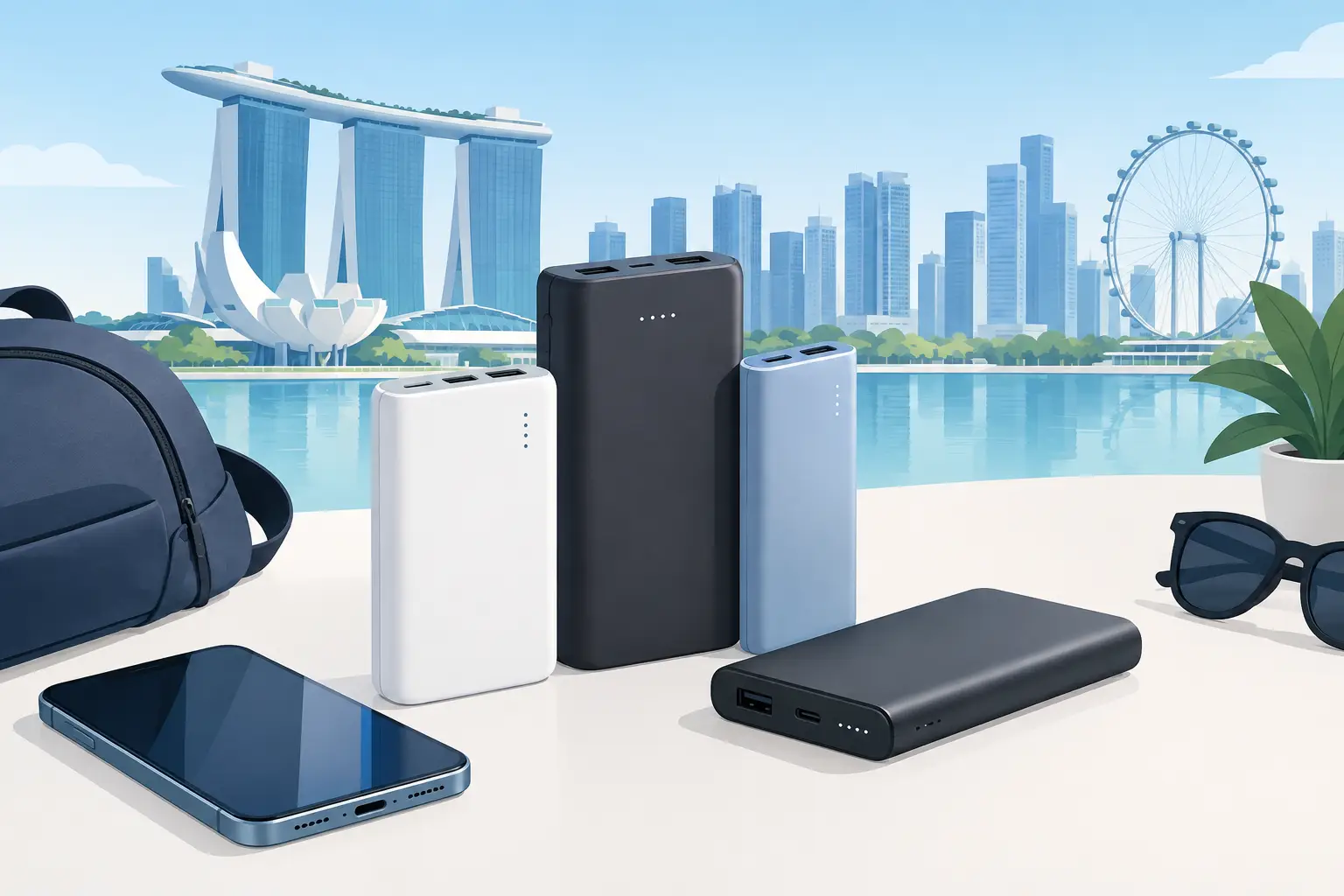
A dead phone at 4% while you are halfway through the day is usually when a cheap power bank starts to feel like a bad bargain. The best power banks Singapore shoppers can buy are not always the biggest or most expensive. They are the ones that charge your actual devices quickly, fit how you commute or travel, and come from a source you can trust.
A good power bank is a simple purchase on the surface, but the labels can be confusing. Capacity, watts, USB-C PD, built-in cables, magnetic charging, and airline limits all matter. Here is how to narrow down the right one without paying for capacity or features you will never use.
What Makes the Best Power Banks in Singapore?
Start with your daily charging problem. If your phone regularly runs low after work, a slim 10,000mAh model is usually the practical sweet spot. If you carry a tablet, spend long days outside, or share a charger with family, 20,000mAh gives you more breathing room. If you need to charge a laptop, capacity is only half the story – you also need enough USB-C output.
Real-world capacity is lower than the number printed on the box. A 10,000mAh power bank will not typically deliver a full 10,000mAh to your phone because energy is lost during voltage conversion and charging. As a rough guide, expect a quality 10,000mAh model to give most modern phones around one to one-and-a-half extra charges. A 20,000mAh unit can often manage two to three charges, depending on the phone battery and how you use it while charging.
The best choice depends on the device in your pocket. A compact iPhone or standard Android phone needs far less power than an Ultra-sized flagship, a tablet, or a handheld gaming console.
Choose Capacity Before Chasing Features
5,000mAh: Best for a small everyday backup
A 5,000mAh power bank is for the person who wants insurance, not a full recharge station. It slips into a pocket or small bag and can rescue a phone before a long commute home. Some magnetic models sit neatly on the back of compatible phones, which is convenient for messages, maps, and light use.
The trade-off is obvious: limited reserve power. Wireless charging also runs warmer and less efficiently than a cable. If your phone is often near empty by mid-afternoon, go bigger.
10,000mAh: Best for most phone users
For most students, office workers, and everyday users, 10,000mAh is the sensible buy. It is portable enough to carry daily, provides useful backup for one or two phones, and is widely available with USB-C fast charging.
Look for a model that can charge through USB-C and has at least one USB-C output. Older USB-A ports are still useful for existing cables, but USB-C gives you a better path forward as more phones, tablets, earbuds, and accessories move to the newer connection.
20,000mAh: Best for long days and multiple devices
A 20,000mAh power bank makes sense for travel, events, delivery work, campus days, gaming, or households that share one charger. It is also the safer choice when you use a power-hungry phone heavily for hotspot, navigation, video, or gaming.
The catch is weight. A large-capacity power bank can feel substantial in a sling bag, and it is less comfortable to hold while your phone is connected. Buy it for its extra runtime, not because bigger automatically means better.
25,000mAh and above: Best for laptops, with a check first
High-capacity units are useful when you need to top up a laptop, tablet, camera, or several devices. But do not buy one based on mAh alone. Check the output rating and your laptop’s charging requirement. A power bank with a large battery but only 20W output will not be a great match for a laptop that expects 45W, 65W, or more.
Fast Charging: Watts Matter More Than Marketing
Fast charging is where many buyers get caught out. A power bank may say “fast charge,” but the real question is how many watts it can output from USB-C.
For phones, 20W to 30W is a strong all-round range. It is enough for fast charging on many current iPhones and Android phones, assuming you use a compatible cable. A 45W power bank is more flexible for larger Android phones, tablets, and certain laptops. For laptop charging, 65W is the practical starting point for many models, while power-hungry laptops may need 100W or above.
Check the power bank’s total output too. A unit may advertise 65W, but that figure can change when two or three devices are connected. If you regularly charge a phone and tablet at the same time, look at the shared-output specifications rather than the biggest number on the front of the packaging.
Your cable is part of the setup. A worn cable can cause unreliable charging, while a basic cable may not support higher wattage. For 60W or 100W charging, use a properly rated USB-C cable. There is no point buying a capable power bank and pairing it with the cheapest cable in the drawer.
Wired, Magnetic, or Built-In Cable?
Wired charging remains the best value when you want speed and efficiency. A USB-C cable charges faster than most wireless options, produces less heat, and lets the power bank work harder for longer.
Magnetic wireless power banks are about convenience. They are handy for short top-ups while you are walking around, checking directions, or waiting for transport. They are not the first choice for a full charge on a hot day, since heat and wireless charging losses can slow things down. If you use a magnetic model, choose one with a wired USB-C option as well.
Built-in cable designs reduce the chance of leaving home without a cable. They are great for quick everyday use, but inspect the cable construction. A damaged built-in cable is less convenient to replace than a separate one. For frequent use, a detachable cable gives you more flexibility.
Safety Is Worth Paying Attention To
Power banks are battery products, not just accessories. Avoid suspiciously cheap units with inflated capacity claims, unclear branding, or no proper specifications. A deal is not worth it if the battery swells, overheats, or fails after a few months.
When comparing options, check for clear details on capacity, input and output wattage, ports, warranty support, and safety protections. Good models commonly include safeguards against overcharging, overheating, short circuits, and excessive current. Buy from a reliable retailer so you know what you are getting and where to go if there is a problem.
A few habits will also extend battery life:
- Do not leave a power bank baking in a car or direct sun.
- Stop using it if it becomes unusually hot, damaged, swollen, or gives off an unusual smell.
- Use a compatible, good-quality charger to recharge it.
- Keep the ports clear of dust, lint, and moisture.
Air Travel and Singapore Commutes
If you fly regularly, check the watt-hour rating, shown as Wh, not only mAh. Most consumer power banks under 100Wh are generally accepted in carry-on luggage, subject to airline rules. Power banks should not go into checked baggage. A common 20,000mAh model is usually well below 100Wh, but confirm the label before packing.
For daily Singapore use, portability often wins. A slim 10,000mAh USB-C PD power bank paired with a good short cable is enough for most commutes, workdays, and school days. Save the 20,000mAh models for travel, long shifts, or situations where charging outlets are not guaranteed.
A Straightforward Buying Checklist
Before checking out, match these details to what you actually carry: capacity that fits your day, USB-C output that fits your device, enough ports for your usual setup, a cable rated for the wattage you need, and a size you will genuinely bring along. A power bank left at home because it is too heavy is not helping anyone.
At Gadget Affair, it makes sense to compare the power bank with your phone, tablet, and existing cables before buying. If you are unsure whether you need 20W, 45W, or 65W, bring the device details along and choose for the way you use it, not the biggest number on the shelf.
The right power bank should disappear into your routine: charged overnight, easy to carry, and ready when your phone needs it. Buy for that moment at the end of a long day, not for a spec sheet you will never use.