A cheap pair of earbuds can look great on the shelf, then disappoint the moment you take a call on a noisy street or wear them for an hour. The best earbuds are not automatically the most expensive pair. They are the ones that fit properly, sound good for the music you play most, and handle your daily routine without becoming another thing to charge, adjust, or replace.
For most buyers, the decision comes down to a few practical questions: Do you need strong noise canceling for commuting? Are calls a priority? Do you want deep bass for workouts, or a balanced sound for podcasts and movies? Once you know that, it is much easier to avoid paying extra for features you will barely use.
What Makes the Best Earbuds Worth Buying?
Wireless earbuds have improved a lot, but not every model gets the essentials right. Marketing often focuses on driver size, codecs, and long feature lists. Those details can matter, but comfort, connection stability, microphone quality, and battery life make a bigger difference for everyday use.
Start with fit. An earbud that seals well in your ear delivers fuller bass, better passive noise reduction, and more reliable active noise canceling. If the tips are too small, too large, or too slippery, the sound will feel thin and the earbuds may loosen while walking. Look for multiple ear tip sizes, and test them before deciding that the sound profile is the problem.
Next, consider the charging case. Earbuds may advertise eight or ten hours of playback, but real-world battery life drops when noise canceling, high volume, and calls are involved. A compact case with enough extra charge for several top-ups is usually more useful than a headline battery figure.
Sound Quality Is Personal
There is no single sound signature that suits everyone. Some listeners prefer strong bass for hip-hop, electronic music, and action movies. Others want clearer vocals and a more natural balance for acoustic tracks, podcasts, or long work sessions.
If you like bass, choose earbuds with punch and control rather than just a heavy low end. Too much bass can cover vocals and make music sound muddy. If you prefer a cleaner sound, look for a companion app with an equalizer. Being able to make small adjustments is more valuable than chasing a spec sheet.
Codec support can help, especially if you use compatible Android devices and listen to high-quality streaming files. Still, it should not be your deciding factor. A secure fit and well-tuned earbuds will usually sound better than a higher-spec model that does not sit properly in your ears.
Noise Canceling Helps, but It Has Limits
Active noise canceling, often called ANC, is one of the best upgrades for regular commuters, travelers, and anyone working in cafes. It is especially effective against constant low-frequency sounds such as train rumble, air-conditioning, bus engines, and airplane cabin noise.
It is less effective against sudden voices, sharp announcements, or nearby conversations. Good ANC reduces the distraction, but it does not create total silence. That is why fit still matters. A proper seal gives you passive isolation before the electronics do any work.
If you mainly use earbuds at home or in a quiet office, basic noise isolation may be enough. Spending more on premium ANC makes sense when you use it often, not just because it is listed on the box.
Best Earbuds by Everyday Use
Instead of searching for one winner, match the earbuds to how you use them. A commuter, gym regular, and remote worker can all need different things from the same product category.
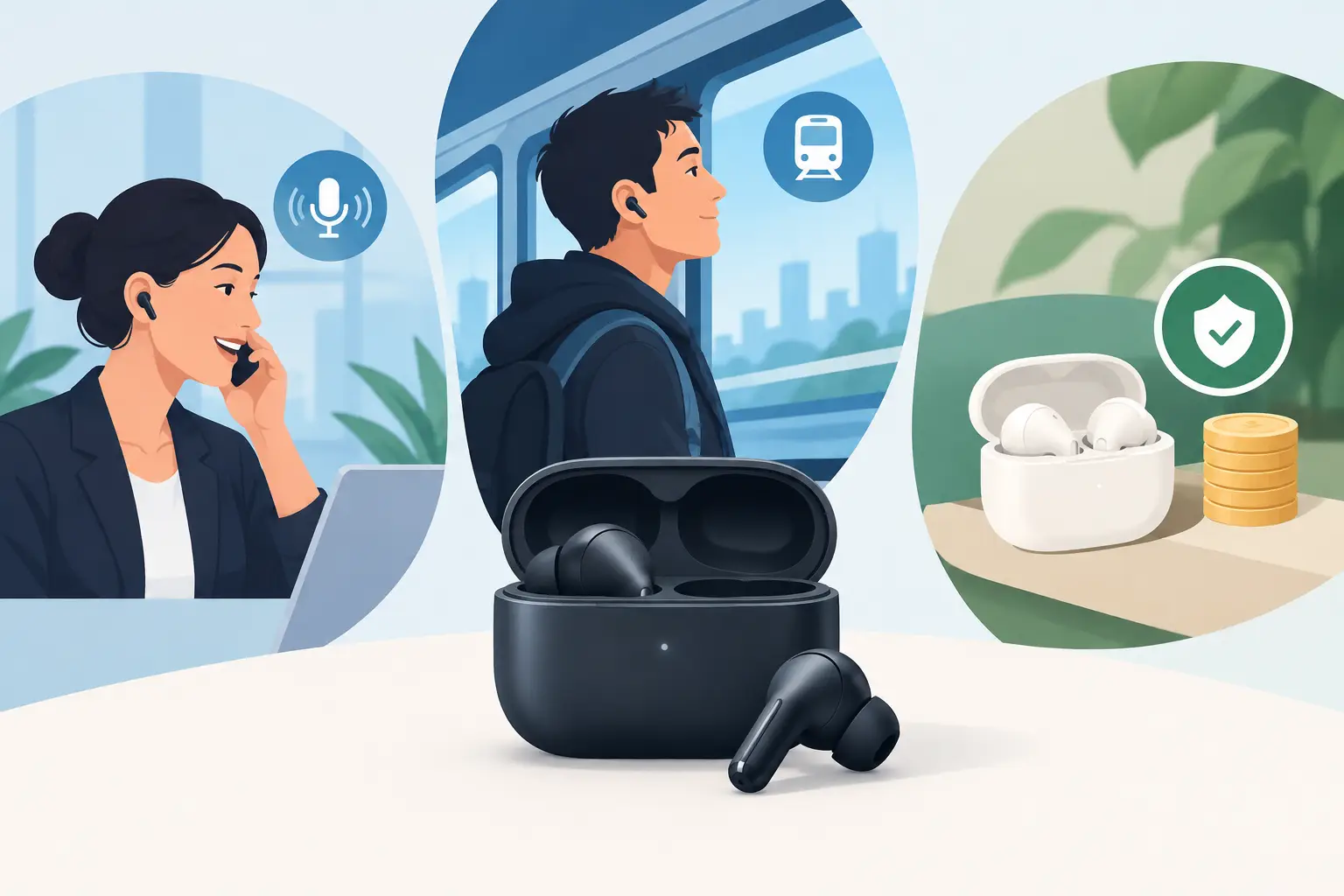
For commuting and travel
Prioritize reliable ANC, a comfortable fit, and a transparency mode. Transparency mode uses the earbuds’ microphones to let outside sound through, which is useful when you need to hear announcements, traffic, or someone speaking to you.
Look for controls that are easy to use without pulling out your phone. Touch controls are common, but they can be frustrating if they trigger when you adjust the earbuds. Physical buttons can be less elegant, yet many people find them more dependable when walking or wearing gloves.
For calls and work
Microphone quality matters more than music tuning if you spend most of your day on calls. Many earbuds sound excellent in your ears but struggle to separate your voice from wind, traffic, or office chatter.
Check whether the model is known for clear voice pickup and background noise reduction. Multipoint connectivity is also worth paying for if you switch between a laptop and phone. It allows the earbuds to stay connected to two devices, so you can take a call on your phone without manually disconnecting from your computer.
Keep expectations realistic outdoors. Even premium earbuds can have trouble in strong wind. For frequent professional calls in noisy places, a headset with a boom microphone may still be the better tool.
For workouts
For the gym, runs, and outdoor walks, a secure fit is the first requirement. Ear fins or wing tips can help, although not everyone finds them comfortable. Water resistance is also important. An IPX4 rating generally covers sweat and light splashes, while a higher rating offers more protection.
Do not assume water-resistant means waterproof. Most earbuds are not designed for swimming, and the charging case is often less protected than the earbuds themselves. Wipe the earbuds dry before returning them to the case to help protect the charging contacts.
A bass-forward sound can make workouts more enjoyable, but do not buy based on bass alone. You also want a pair that stays put when you move and provides enough battery for a full week of training.
For value-focused buyers
Midrange earbuds are often the smart buy. This is where you can find solid ANC, app controls, good battery life, and decent call quality without paying flagship pricing. The trade-off is usually in refinement: premium models may have better microphones, more natural transparency mode, improved comfort, and stronger device integration.
Budget earbuds can still be a good pick for casual listening, backup use, or students who want something simple. Focus on known brands, clear warranty support, and realistic features. Be cautious with listings that promise premium-level noise canceling, massive battery life, and high-end audio at an unusually low price. Something usually has to give.
Features That Are Actually Worth Paying For
Some extras genuinely improve ownership. Wireless charging is convenient if you already use a charging pad, though it is not essential. An app with an equalizer, firmware updates, and adjustable ANC is more useful because it gives you control after purchase.
Multipoint is valuable for people who work across devices. A wear-detection sensor is convenient for pausing music when an earbud is removed, but it can occasionally misread movement. Spatial audio can be fun for movies, yet it is not a reason by itself to spend more.
Battery health is another detail buyers overlook. Like phones, rechargeable earbuds lose capacity over time. If you are buying a pre-owned pair, ask about the condition of both the earbuds and the charging case, whether the case charges properly, and whether the ear tips and cables are included. With personal audio products, hygiene and warranty coverage deserve extra attention.
How to Choose Without Overthinking It
Set a budget first, then pick your top two priorities. For example, you may want strong ANC and clear calls, or a secure gym fit and long battery life. Most earbuds are good at several things, but few are outstanding at everything.
If possible, test comfort before buying. Wear the earbuds for more than a minute, move your head, and check whether the controls feel natural. If you are considering a verified pre-owned option, inspect the case hinge, charging port, contact pins, and pairing behavior. These simple checks can save you from a frustrating purchase.
Brand ecosystem can matter too. Some earbuds offer extra features when paired with phones from the same brand, such as faster pairing, device switching, or expanded audio settings. That convenience is useful, but do not let it override fit and core performance.
The right pair should disappear into your routine: easy to carry, comfortable enough to wear, clear when you need to talk, and reliable when you hit play. Start with the features you will use every day, test the fit where you can, and let the price follow the value you are actually getting.